
LETTER TO THE SOCIAL WORKER (2019)
To Whom It May Concern:
Alice L. Hill is my mother. She is in denial about dementia. My reality is that Mom has always shown behavior similar to dementia that she denies, and it is progressing with age.
In the past two years, Mom has undergone scans and evaluations from head to toe — literally. None were related to new injuries. These include but are not limited to: nerve function evaluation; MRI of her brain; pelvic, neck, lumbar, foot, sacrum, and coccyx X‑rays; ultrasound for veins in her legs; a swallowing study with barium X‑rays; and multiple blood tests. She is unable to communicate effectively about her health history. Underlying all of this is a chronic pain condition that should be addressed as a priority. Over the past month, I have been trying to make a coherent narrative by reviewing her medical records.
There have been several medications that Mom has tried. She consistently reports negative effects. However, she does things that muddy the waters regarding how she is tolerating them. For example, she was taking Benadryl capsules and then reporting that her prescription medication made her drowsy. Mom becomes adversarial or plays coy when I try to reason with her about what she has taken. I tried to get her to go back on gabapentin and memantine by starting gabapentin for a week and then adding memantine. She took both on the second day and experienced vertigo. I cannot get her to recognize that she is not necessarily “allergic” to each of them. The adverse reaction to both together — before her body had time to adapt — is all we can know for certain.
Because I have medical power of attorney, I believe that, for the first time in Mom’s life, someone is knowledgeable enough to advocate effectively for her whole health. It has only been about four months since I came into possession of the document Mom executed prior to her dementia diagnosis.
Since Mom has had a caretaker assigned to her, I have noticed that her medical needs have changed. The pattern has been erratic. She has been to the doctor multiple times in recent weeks without any significant improvement in her complaints. At least one visit did not even address her symptoms at the time but focused on other issues. It became apparent to me that I needed to act on her behalf. Until now, I had not engaged much, assuming her care and management were adequate. That changed on December 6, when her dental surgeon did not consider her able to give informed consent for the extractions she was scheduled for. I was called in from the waiting room to assist with medical history and consent on her behalf.
Mom’s lifelong history suggests early neurological damage that was never treated. Because of that damage, she has never been able to communicate consistently or clearly about her health. Chronic pain and a poorly formed sense of self have impacted every aspect of Mom’s life — and, by extension, my own.

IUSTITIA FOR ALICE
From the distance only time can give, I can now see that I was writing from a place of trauma. This was a reactive response to what would not be the last false report my mom made against me, my attempt to put the genie back in the bottle.
This essay was written contemporaneously — in the middle of events, not after them. I had no attorney. I had no clinical training. I had a lifetime of watching, an electronic box of medical records, and the stubborn belief that my mother's story deserved to be told candidly. Along the way, I was told by a program director that my relationship with Mom’s medical providers had become “adversarial.” That word was theirs, not mine, but it describes the position I was pushed into while trying to protect her. What follows reflects the circumstances and understanding of that time. The court battles for guardianship were yet ahead. Understanding neurodivergence was yet further ahead at the time of writing. This essay is a waypoint in a longer journey.
CHAPTER 1 — MOM'S STORY
The account of Alice Lorraine Hill’s survival and perseverance is a story of the human spirit’s ability to adapt — and maladapt — to horrific conditions. I will try to describe most of the traumas Mom survived.
Her story deserves to be told.
Mom’s thinking and memories are skewed toward distrust and imputing wrong motives. As long as I can remember, this has been so. My life path was steered by these tendencies. Yet there are consistencies to the telling and retelling — enough that I will recount what I have pieced together. There are some parts missing. There are parts that do not seem possible. But the stories have been consistent enough to say that Mom truly believes the events and relationships I describe.
I will touch on physical illnesses later in this account. Mom’s medical history is another story to tell. But know this: the trauma in Mom’s life carved its way into her spirit and left an indelible mark on her physiology and psyche.
The term “adverse childhood experiences” should be common knowledge for anyone interested in human behavior. Extreme cases of early neglect — known as global neglect — accurately describe Mom’s early life. Mom’s life continued to be a series of adverse experiences stretching into adulthood.
CHAPTER 2 — INFANCY: BORN INTO REJECTION
Mom was born to a mother who had a psychotic break in the third trimester of pregnancy. Her name was Alma. That she could not walk up the stairs unassisted suggests there was a catatonic aspect to this break.
Born at home, Mom was very sick and was immediately taken to the hospital. She did not improve there. Projectile vomiting of any liquids ingested could not be controlled. This was long before neonatal intensive care was standard. I picture a crib that was unattended except for scheduled feeding and changing. The hospital discharged her after two months. My research suggests that she had insufficient stomach acid and the cascading nutritional deficiencies and allergies that followed from that.
There are no stories from Mom for me to know how long Alma's recovery took. I do understand that for a year, Alma forbade the crying infant to be in the house after Mom was sent home from the hospital.
When she came home, her dad set up an improvised NICU with an electric chicken egg incubator. It was in an outbuilding they used as a milk cellar on a working dairy farm. This was the cold month of March in Oklahoma. “Disturbed the other children” was Alma's justification for forbidding her infant to be in the house. This was a literal maternal rejection that cannot be replicated in any ethical experiment. Recent research into trauma-informed care suggests the neurological damage this early neglect caused was significant.
Mom's father, Robert, and a hired farmhand nursed Mom with hourly feedings of boiled goat's milk and rice starch. They took twelve-hour shifts, Mom says. She believes that she was nurtured and loved by her father. I do not doubt his love for her. I do doubt that there was much time for her — with a sick wife, young siblings, and a working dairy farm to run. Remember that the mother had been previously bedridden.
For as long as he was able, Robert searched for answers to Mom's extreme allergies and frailty. This was a source of fighting between the parents. It seems that Robert would spare no cost, and that Alma begrudged any penny spent. Alma was also physically abusive to the children, and Mom remembers arguments about that. Mom says that Robert would say, “Alma, one day you're going to hurt the children.” And she did.
With my understanding of abusive family dynamics, I think Mom was the target for most of the violence from Alma. Mom also recounts kitchen conversations among adult family members — that mom’s birth was a punishment from God to Alma. Alma played the victim because of Mom being so sickly.
The era of Mom's childhood was Dust Bowl Oklahoma. Food scarcity was unavoidable for everyone, and even more erratic for Mom because of her food allergies.
CHAPTER 3 — CHILDHOOD: FARMED OUT (CAPTIVITY) AND TERROR
At the age of seven, Mom's dad was committed to a state mental hospital. By that time, he was known as “crazy old man Hill.” The records I have seen note hardening of the arteries and dementia, if I remember correctly. Mom said he would wander the countryside in his nightclothes in a sleepwalking state she came to believe was a form of seizures. He died at that hospital three years later.
Soon after he was sent away, Mom was farmed out to an elderly neighbor. Mrs. Skibby was a paranoid-schizophrenic immigrant widow. Her place was isolated. She had suffered a stroke, was crippled, and spoke broken English. Because of the woman's paranoia — perhaps justified — she had a German Shepherd that was war-trained as an attack dog. The dog was tasked with limiting Mom's movements. There was no straying; this dog was always on watch. The windows on that home were nailed shut due to the widow's paranoia and hallucinations.
After Mom was farmed out, she shared a bed with her sister when she visited home. These visits gave the sister a chance to avoid being molested by their oldest brother. They switched places in the bed because he would go away when he found Mom instead of the intended victim of his incest. Alma delegated punishment — whippings — of her and the other siblings to this eldest brother. He was extremely violent and sexually abusive. He mutilated animals and used gunshots to make the children “dance” as he shot at the ground near their feet.
The chronology is muddied for me, but that sister became pregnant from the incestuous rapes. When the girl told Alma, she went into a rage and called Etta a liar. Their mother assaulted Etta and bashed her head into the chimney. Afterward, Etta drank Lysol to commit suicide. She survived but lost the baby.
Mom's sister was removed from the home after that. I do not know exactly what happened, but she ended up living in California. The brother was given the option of criminal charges or the military. Alma signed papers for him to go into the Army as a minor, and he left immediately.
If any part of Alice’s story touches your own,
then I ask you to help me interrupt this cycle.
CHAPTER 4 — ADOLESCENCE: SEXUAL VIOLENCE AND MEDICAL BETRAYAL
In middle school, Mom played softball for the school without her mother's knowledge. During one game, she sustained an injury that “crushed” her tailbone. The pain was excruciating, but she hid it because she would have received a beating for wearing pants instead of a dress to play.
I believe the sister was gone by the time Mom graduated middle school — eighth or ninth grade. She got a ride home from the graduation ceremony with her brother's best friend. He did not take her directly home. When he parked on an isolated back road, he raped her. Mom was taught it was the girl's fault if she was raped, so she told no one. She was a virgin and had not started menstrual cycles.
Several years later, while working as a nurse's assistant at a hospital, she assisted a woman who had miscarried. Only then did she realize that what she had thought was a horrible first menstrual cycle was actually a miscarriage from the rape. She went through that miscarriage hiding what had happened.
Mom continued to be sickly. With her mother not inclined to seek medical help for any reason, Mom suffered. Mrs. Skibby would take Mom home when she got ill and offered to pay for medical help, and Alma refused. The two women would fight about Mom being sick. Alma would tell Mrs. Skibby, “You had her when she was well, so you can keep her when she's sick.” Mrs. Skibby would tell Mom she was unlovable and that her own mother did not love her.
One illness was caused by erysipelas — a bacterial infection unrelated to syphilis that can cause serious skin and systemic symptoms. It caused head-to-toe skin rashes that threatened blood poisoning by the time Alma took her to the doctor. The small-town people believed Mom had a venereal disease. Her mother was college-educated but allowed that misunderstanding. This was to deflect from the accusation of criminal neglect on Alma's part in not getting Mom medical care sooner. Mom says that people lined up the blocks to see her come and go from the doctor's office. The rumor was that Mom snuck out at night to be with men. This rumor was a direct influence on the boy who raped Mom on her graduation night. Years later, he apologized and said he knew it was false when he saw the blood from her torn genitals.
Mom had to be taken into town twice a day for penicillin shots. The doctors threatened her mother with murder charges if Mom died. She recovered slowly.
Alma remarried a violent alcoholic. The eldest brother had returned from military service by then. Somehow, local social services removed the younger children from Alma's custody because of the abuse from the stepfather. Mom says that at one point, when she was held with a gun to her head by the husband, she told him to go ahead and shoot — and that she meant it. The court awarded custody to the eldest brother. I do not understand how. Mom was fourteen or so.
CHAPTER 5 — YOUNG WOMAN: WAR BRIDE AND SURVIVAL
The sister who had moved to California made arrangements for Mom to become a war bride to a friend of her husband. She sent money for Mom to travel to San Diego, where Mom married at fifteen years old before the man left for an overseas tour of duty. Etta paid for Mom to take modeling classes so she could work as a tearoom model for upscale department stores. It seems that Mom was on her own for most of the next year or two.
Soon after Mom turned seventeen, she was raped again. This assault was vicious, she said. She was terrified to be alone after that. She knew a young man who was kind to her and who really cared for her. She did not tell him about the rape. She certainly had not told him she had an estranged marriage. There was sexual intimacy with this man. Mom got pregnant but believed the father to be the rapist.
Apparently, her husband reconciled with her because he claimed the baby as his own. I assume he was on tour, because after the baby was born, Alma made arrangements for Mom to go live with maternal aunts in Idaho. When Debi was born, Mom knew by her complexion and features that she was not the baby of the rapist. She was the baby of the man who had cared about her. When Mom realized she was pregnant, she had left him with no explanation, so he had no knowledge of the child.
Mom worked for the aunts in exchange for room and board for herself and the baby. The aunts ran a brothel that served a logging camp of considerable size. Mom's job was to tend the children of the working women. Apparently, the aunts ran the business with authority, because Mom says they threw out a man who tried to choose her for services and would not take no for an answer. The aunts respected Mom's wishes not to be a sex worker.
I do not know much about the next years. Pamela was born when Mom was twenty.
CHAPTER 6 — MOTHERHOOD, PSYCHIATRY, AND AMNESIA
Mom had a hard time delivering the second child. There was hemorrhaging and multiple blood transfusions. The newborn and my oldest sibling, who was three at the time, were placed in private foster care while Mom was hospitalized. I do not know where the husband and father of the second child was. I assume he was again on military tour.
Mom was under psychiatric care after the birth. I think it was a mental hospital she self-admitted to after being released from the military hospital where my sister was born.
During this hospitalization, Mom received electric shock therapy. She speaks well of the psychiatrist. He showed compassion and understanding and attempted to give her clinically induced amnesia. To get her consent, he explained that he wanted to wipe “the slate clean.” “Everything she had been taught was wrong” is how Mom recounts his evaluation.
The electric shock treatment did not go well. She fell out of the hospital bed and sustained a back injury. The amnesia was induced and continued for several years. Mom describes seizures in her medical history that were induced by the electric shock therapy.
Mom recovered enough that she and the two girls joined her husband in France. He abandoned them there by denying her the paperwork for military passage back home. Mom had to hustle up the money to get them home by reselling American cigarettes on the black market in Paris. They divorced when Mom got back to the United States.
That brings Mom's story to her mid-twenties.
CHAPTER 7 — THE BODY KEEPS THE SCORE: MEDICAL HISTORY
I do not have a complete chronology, but Mom's medical injuries and illnesses include the following:
Four major car wrecks
Gallbladder surgery
Appendix surgery
Hysterectomy from uterine cystic disease
Partial thyroidectomy for a cyst obstructing her airway
A bleeding ulcer aggravated by aspirin intake, requiring hospitalization and blood transfusions
GERD and Barrett's esophagus; some dysfunction in swallowing action per recent barium X-rays
Hiatal hernia from a birth defect; fundoplication for that hernia in 1976; recovery was difficult because her incisions would not knit together, requiring complete bed rest for several months
A broken nose and repair of a deviated septum; a surgical re-breaking and then re-injury days after the surgery (she counts three broken noses)
Multiple back injuries
Neck injury sustained from a physical assault by her second husband
Gastric and digestive issues created uncontrollable flatulence and belching — socially unacceptable from childhood through late adulthood. My way of dealing with it as a kid was to imagine she could self-propel from the flatulence if she put on roller skates. It was excessive. This has subsided significantly since we focused on naturally raising her stomach acid production. She avoids meats and overcooks her foods to reduce discomfort swallowing.
Debilitating migraines through her forties. She says the longest lasted thirty-six hours and that the two oldest girls were unsupervised during that spell when they were young. Onset was sudden enough that a few times she would have to pull over while driving and wait them out.
Balance issues making her clumsy and prone to injury, and poor spatial perception. She says she never had good peripheral vision.
A taste blindness — a dullness of taste I liken to color blindness. She just does not perceive flavors the way everyone else does.
Rashes and swelling frequently during childhood
Raynaud's syndrome in her hands
Cold intolerance
Low blood pressure
CHAPTER 8 — THE MIND ALICE BUILT TO SURVIVE
As far as Mom's mental wellness is concerned, there have always been personality oddoties. Suggestive of the complexity is Mom's lifelong obsession with schizophrenia not being a family illness.
Impaired executive functioning manifests as poor risk-benefit analysis. Oddly, all of my life, something as simple as a lotion pump has never been utilized by Mom. She just cut off the straw rather than figuring out the release of the spring action.
She lacks the ability to sit for extended periods of time. This suggests a hyperactivity disorder of some sort, though she claims it is caused by injuries. This affected her ability to hold jobs.
She believes she had a type of seizure that would cause momentary lapses of consciousness. She would be in the same posture — sitting or standing — when she recovered as when the blackout started. These were micro-blackouts, from what I understand.
Psychosomatic narcissism adversely affected her parenting.
A level of social awkwardness that I can only describe as autistic. She does not read social cues or body language well. Her conversations become tangential and self-focused. Socially inappropriate comments make relaxed conversation with her difficult.
Mom fell asleep at the movie theater showing Black Panther. My guess is sensory overload. She does not watch television or movies that are not news or documentaries, by choice.
Mom had a photographic memory until very recently. This ability — and knowing how to work the system of college work-experience credits and course challenging — enabled her to obtain college credits that significantly contributed to her degrees. Her level of education does not reflect the type of successful social engagement expected for a normal college career.
Her efforts to show empathy lack authenticity, suggestive of mimicry rather than naturally occurring feeling.
There was no physically nurturing contact that I remember from childhood. In one social situation, she gave me a hug that elicited a feeling of repulsion from me when I was about seven. I remember thinking it was an act to impress an adult bystander.
Mom recounts a story of me being bitten by another child when I was a toddler and that for a short time afterward, I would bite myself to get attention. She thought it was funny. I think it suggests that deprivation of attention was my motive for self-injury as a means of getting noticed.
Mom has always been a conspiracist. Most dominant was her belief that her father was wealthy and his fortune was stolen. She obsessed over legal research to vindicate that. She obsessed over research on mental illness to clear his name of the “crazy old man Hill” reputation.
Mom has a very established victim identity. Not atypical of that is a history of accusing my daughters — when they were six and eight years old — of elder abuse.
Compulsive behaviors persist. Two winters ago, she boxed up leaves, accumulated the boxes, and saved bottles of water for irrigation going into winter. It looked like an accumulation of garbage. I received a notice of complaint from the city about illegal garbage accumulation. It was cardboard boxes full of leaves. This is not atypical of lifelong patterns of behavior.
She is very goal-oriented to the point of obsessiveness. She is very productive in the garden and will spend hours repotting plants and propagating cuttings successfully. There has always been a gap between her lack of botanical knowledge and her successful propagation. I jokingly call her a goat because of her focus and tenacity controlling noxious weeds on our property. When motivated, she is very agile — climbing on top of worktables or the embankment that borders our garden.
Mom has always had difficulty pronouncing some words. “Vegetable” is pronounced as “vestible.” These are not explained by any accent, regional or otherwise. A number of words would be replaced with similar-sounding words. The only example I can think of is “parameter” instead of “perimeter.” Although that is not an actual instance of her usage, it illustrates the condition. Age-related lack of word recall has been noticeable only over the last couple of years, as a distinction from this lifelong pattern.
I believe that Mom uses her health issues as a means of establishing connections with people. She plays to the audience in that her mobility is impacted by her unidentified need for attention. Our security camera shows she has more strength and agility than she realizes when she is engaged in a task that has a rewarding goal. Sadly, the pattern established early in her life was that only illness got her noticed by others.
She is very successful in casual social settings and presents as charming — unless she feels threatened. That is a veritable trip wire for releasing bitterness and cunning.
EPILOGUE — A WEAPON BECOMES A REMEMBRANCE
Up to this point, I had written under pressure: to document, to persuade, to protect my mother in the eyes of doctors, agencies, and the court. Then, in the last year, Mom's decline accelerated. She went into a nursing home to recover from a fall and broken ribs, and the demands on me intensified at the same time my job and career responsibilities did. This body of work did what it needed to do: it helped me secure full legal guardianship and advocate for Iustitia for Alice — justice for my mother in the systems that had failed her. In that sense, this narrative became a weapon, and once the goal was achieved, it had to be set aside so I could attend to the realities of her care and my own life. Now, returning to it, I am no longer wielding it as evidence but polishing it and placing it in a kind of showcase for remembrance — a record of who she was, what she survived, and what it has meant to be her daughter.
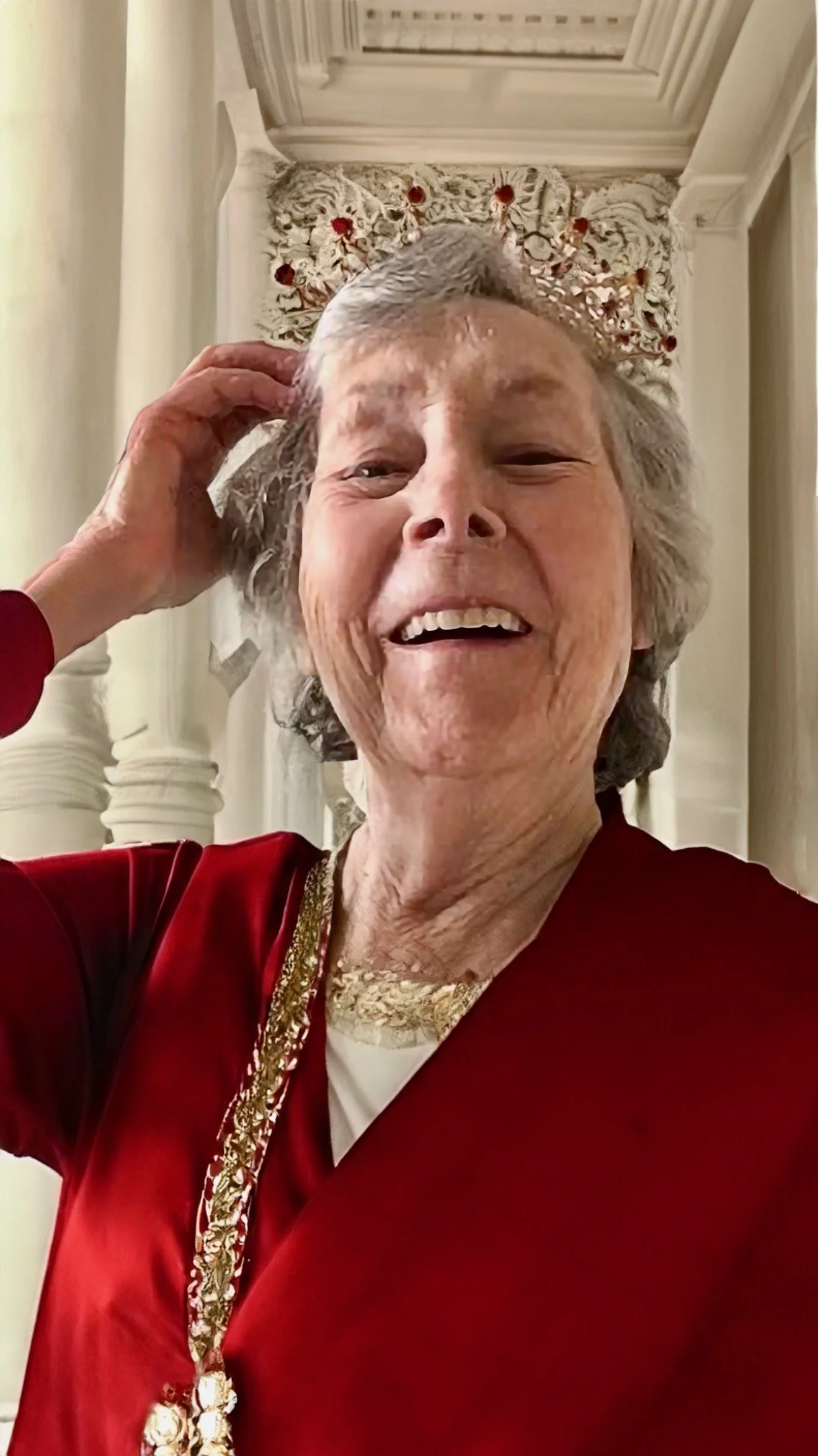
The Life of Alice Lorraine Hill
As told by her daughter